About ICTESAI 2025
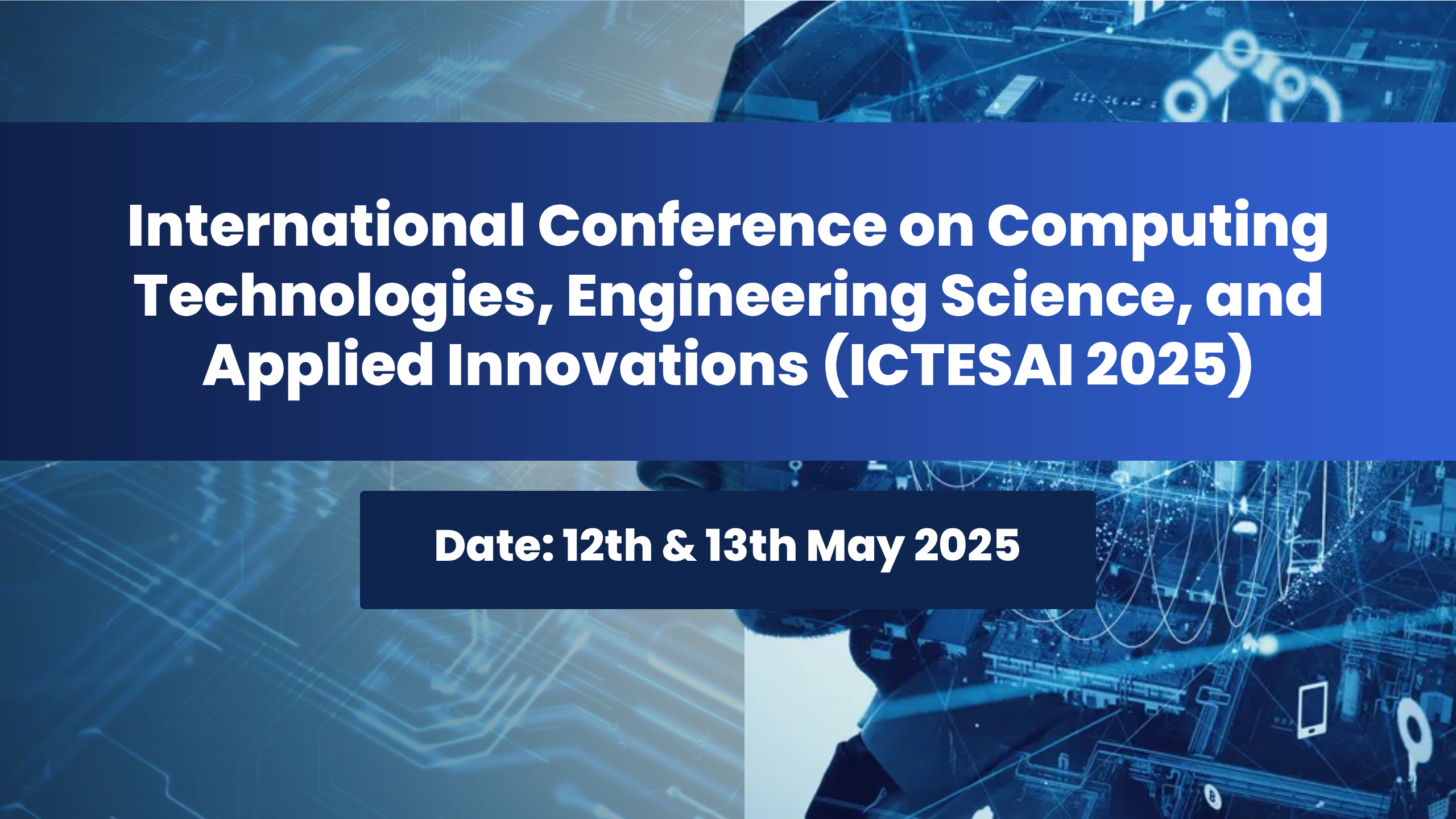
The International Conference on Computing Technologies, Engineering Science, and Applied Innovations (ICTESAI 2025) aims to bring together researchers, industry professionals, academicians, and innovators across multiple disciplines to exchange knowledge, showcase advancements, and discuss emerging trends. The conference provides a platform for presenting cutting-edge research in computing, engineering sciences, and real-world applications that promote technological innovation and sustainable development.
ICTESAI 2025 emphasizes the integration of computing technologies, engineering principles, and applied innovations to solve complex societal, industrial, and scientific challenges. It encourages multidisciplinary collaboration, fosters innovation-driven research, and supports the dissemination of new methodologies, models, and frameworks that contribute to global technological evolution.
The conference welcomes submissions from all areas of computing, engineering, and applied sciences.
Organized By
InnovateSciTech
In Association With
International Journal of Research and Applied Innovations (IJRAI) - www.ijrai.org
Conference Tracks
Track 1: Computing & Information Technologies
- Artificial Intelligence & Machine Learning
- Deep Learning and Neural Networks
- Data Science, Big Data Analytics
- Cloud, Edge & Fog Computing
- Distributed and High-Performance Computing
- Internet of Things (IoT) & Sensor Networks
- Intelligent Software Systems
Track 2: Computer Engineering & Systems
- Computer Architecture & VLSI Design
- Embedded Systems & Real-Time Computing
- Cyber-Physical Systems
- Robotics, Automation & Autonomous Systems
- Quantum Computing & Emerging Architectures
- Communication & Networking Technologies
Track 3: Electronics & Communication Engineering
- Signal Processing & Image Processing
- Wireless Communication & 5G Technologies
- Microelectronics & Semiconductor Technology
- RF, Microwave & Antenna Systems
- Optical Communication Systems
Track 4: Electrical & Power Engineering
- Smart Grids & Renewable Power Systems
- Electrical Machines & Drives
- Energy Storage Systems
- Power Electronics & Control Systems
- Sustainable Energy Technology
Track 5: Mechanical, Civil & Industrial Engineering
- Advanced Manufacturing & Industrial Automation
- Materials Science & Nanomaterials
- Thermal Engineering & Fluid Dynamics
- Structural Engineering & Smart Infrastructure
- Construction Management & Sustainable Engineering
Track 6: Emerging Engineering Science
- Biotechnology & Bioengineering
- Environmental Engineering & Climate Solutions
- Applied Physics & Mathematical Modeling
- Aerospace & Automotive Engineering Innovations
Track 7: Applied Innovations & Interdisciplinary Research
- Smart Cities & Digital Infrastructure
- Healthcare Technology & Biomedical Innovations
- Human–Computer Interaction & AR/VR
- Blockchain, FinTech & Cybersecurity
- Engineering Education & Innovative Pedagogy
Indexing
Papers presented at ICTESAI 2025 will be considered for publication in partnering journals and may be recommended for indexing based on quality and relevance.
Note: Conference proceedings and selected papers may be recommended for publication in Scopus, SCI, or UGC-CARE indexed journals subject to meeting the respective journal's quality standards and publication criteria.
Keynote Speakers
Dr. Alireza Heidari, Ph.D., D.Sc.
Head, Cancer Research Institute (CRI), California South University (CSU), California, USA
Mr. Tamilsevan Arjunan
Senior Software Engineer, London, United Kingdom
Conference Session Chairs
Dr. A. Rengarajan
Professor, Jain University, Bengaluru, India
Dr. K. Saravanan
Professor, RMD Engineering College, Affiliated to Anna University, Chennai, India
Reviewers
Dr. Douglas Yung
Department of Electronic Engineering, The Chinese University of Hong Kong, Hong Kong
Dr. Sudarson Jena
Department of Information Technology, GITAM University, Hyderabad, India
Dr. Barbaros Preveze
Department of Electronics and Communication Engineering, Cankaya University, Turkey
Sreenivasulu Ramisetty
Data Architect, Georgia, USA
Neha Tyagi
Senior Vice President, Bank of New York (BNY), USA
Dr. P. N. Girija
School of Computer & Information Sciences, University of Hyderabad, Hyderabad, India
Vamsi Krishna Eruvaram
Senior Data Engineer, Lowe's, Phoenix, United States of America
Dr. Mohd Fadzli Mohd Salleh
School of Electrical & Electronic Engineering, Universiti Sains Malaysia, Malaysia
John S. Raj
Independent Researcher, Texas, USA
Yeshwanth Valaboju
Technical Manager, Rigved Technologies Pvt. Ltd, India
Dr. A. K. Sharma
Department of Computer Science and Informatics, University of Kota, Rajasthan, India
Dr. S. V. M. G. Bavithiraja
Department of CSE, Hindusthan Institute of Technology, Coimbatore, India
Dr. Bassel Soudan
University of Sharjah, United Arab Emirates
Dr. Dinesh Kumar Saini
Faculty of Computing and Information Technology, Sohar University, Sultanate of Oman
Dr. Ushaa Eswaran
Department of ECE, Velammal Engineering College, Chennai, India
Sudheer Kumar Shriramoju
Project Manager, Wipro InfoTech, Hyderabad, India
Akinwale Ishola
Eastern Illinois University, Illinois, United States of America
Schedule & Registration
| Event | Date |
|---|---|
| Deadline for Submission | 30th March 2025 |
| Revised Article Submission | 10th April 2025 |
| Early Bird Registration | 15th April 2025 |
| Registration | 25th April 2025 |
| Conference Date | 12th & 13th May 2025 |
| Conference Mode | Virtual |
Registration Fees
Regular Author
Listener (Co-Author)
Research Scholars / Students
Corporate
Additional Page Charges: A paper may have a minimum of 5 pages and a maximum of 10 pages without any additional charge. For papers exceeding 8 pages, an extra page fee of Rs. 200 (or 10 USD) per page will be applied.
Author Guidelines
IADIER Conferences cordially invites authors to submit their papers in accordance with the prescribed submission guidelines.
Page Limit
Each paper should normally be up to 8 pages. Papers exceeding this limit will incur an additional page charge. Authors must follow the official conference paper template.
Content Requirements
We invite authors to submit full-length, original research papers that include references, tables, figures, and results. Submitted work should present unpublished research findings, whether theoretical or experimental.
Originality and Publication Status
All submissions must be original and not under consideration for publication elsewhere. Manuscripts should comply with the conference style and formatting requirements and may be subject to peer review and editorial adjustments.
Submission Process
Authors should submit the full manuscript via the conference email ID before the submission deadline.
Additional Page Charges
A paper may have a minimum of 5 pages and a maximum of 10 pages without any additional charge. For papers exceeding 8 pages, an extra page fee of Rs. 200 (or 10 USD) per page will be applied. Authors will be notified of the reason for the additional charge at the time of acceptance.
Submission Standards
Authors must uphold the highest standards of academic and professional ethics when submitting their work to the conference. Every submission should reflect:
Core Responsibilities of Authors
- Originality: Manuscripts must be original and should not be under consideration at any other journal, conference, or publication platform.
- Accuracy & Integrity: Data, methods, results, and conclusions must be presented honestly, without fabrication, falsification, or manipulation.
- Proper Acknowledgment: All sources, references, prior work, funding agencies, and collaborative contributions must be clearly credited.
- Transparency: Any potential conflicts of interest — academic, financial, or personal — must be fully disclosed by the authors.
Ethics & Standards
Ethical Commitment of IADIER Conferences
IADIER Conferences maintain a strong commitment to responsible conduct, ensuring that all participants — authors, reviewers, organizers, speakers, and delegates — follow a robust ethical framework. The guiding principles include:
1. Fairness & Impartiality
A transparent, unbiased, and equitable review process is ensured for all submissions, regardless of author background, affiliation, or geographical region.
2. Integrity & Intellectual Honesty
All participants must present their ideas, research, and findings truthfully, with proper recognition of intellectual property and correct citation practices.
3. Confidentiality Protection
The confidentiality of submitted manuscripts, reviewer identities, and any sensitive or proprietary information shared during the conference shall be strictly maintained.
4. Conflict of Interest Management
Participants must avoid situations that may compromise professional judgment and are required to openly declare any potential conflicts to maintain the credibility of the review and decision-making process.
5. Inclusivity & Non-Discrimination
The conference promotes an inclusive environment that respects diversity and offers equal opportunity to all, irrespective of gender, race, nationality, religion, or personal characteristics.
6. Responsible Collaboration
Constructive interaction, knowledge sharing, and mutual respect among participants are highly encouraged while ensuring the rights and contributions of all individuals are respected.
7. Environmental & Social Responsibility
The conference advocates sustainable practices and supports initiatives that contribute positively to the environment and society.
8. Positive Societal Impact
Research that advances public welfare, promotes real-world solutions, and contributes meaningfully to society's growth and well-being is strongly encouraged.
Copyright and Licensing
All papers submitted to the conference remain the intellectual property of the authors. By submitting, authors grant the conference a non-exclusive license to publish and distribute the work in the conference proceedings, both in print and online. Submissions must be original and unpublished elsewhere, with proper acknowledgment of all sources and collaborators.
Code of Conduct
The conference's code of conduct, which encourages a civil and welcoming atmosphere, is intended to be followed by all attendees. Discrimination, harassment, and other unethical actions will not be accepted.
Plagiarism Policy
Plagiarism refers to the unauthorized use or reproduction of another author's words, ideas, or expressions, and presenting them as one's own original work. It constitutes a serious breach of academic integrity and ethical conduct. Acts of plagiarism — including direct copying, paraphrasing without acknowledgment, or using data, concepts, or results without proper citation — are considered intellectual dishonesty.
Keynote Invitation
Interested keynote speakers may submit the following information to ictesai2025@innovatescitech.org
- Full Academic and Professional Profile
- Photograph
- Full Name & Affiliation
- Short Biography
Get in Touch
For any questions or clarifications, feel free to contact us through the following channels:
We look forward to your participation in ICTESAI 2025!